
Weekly Market Commentary
December 29th, 2025
Week in Review…
It was a shortened week due to the Christmas holiday, but several key economic reports were released that provided a snapshot of current conditions.
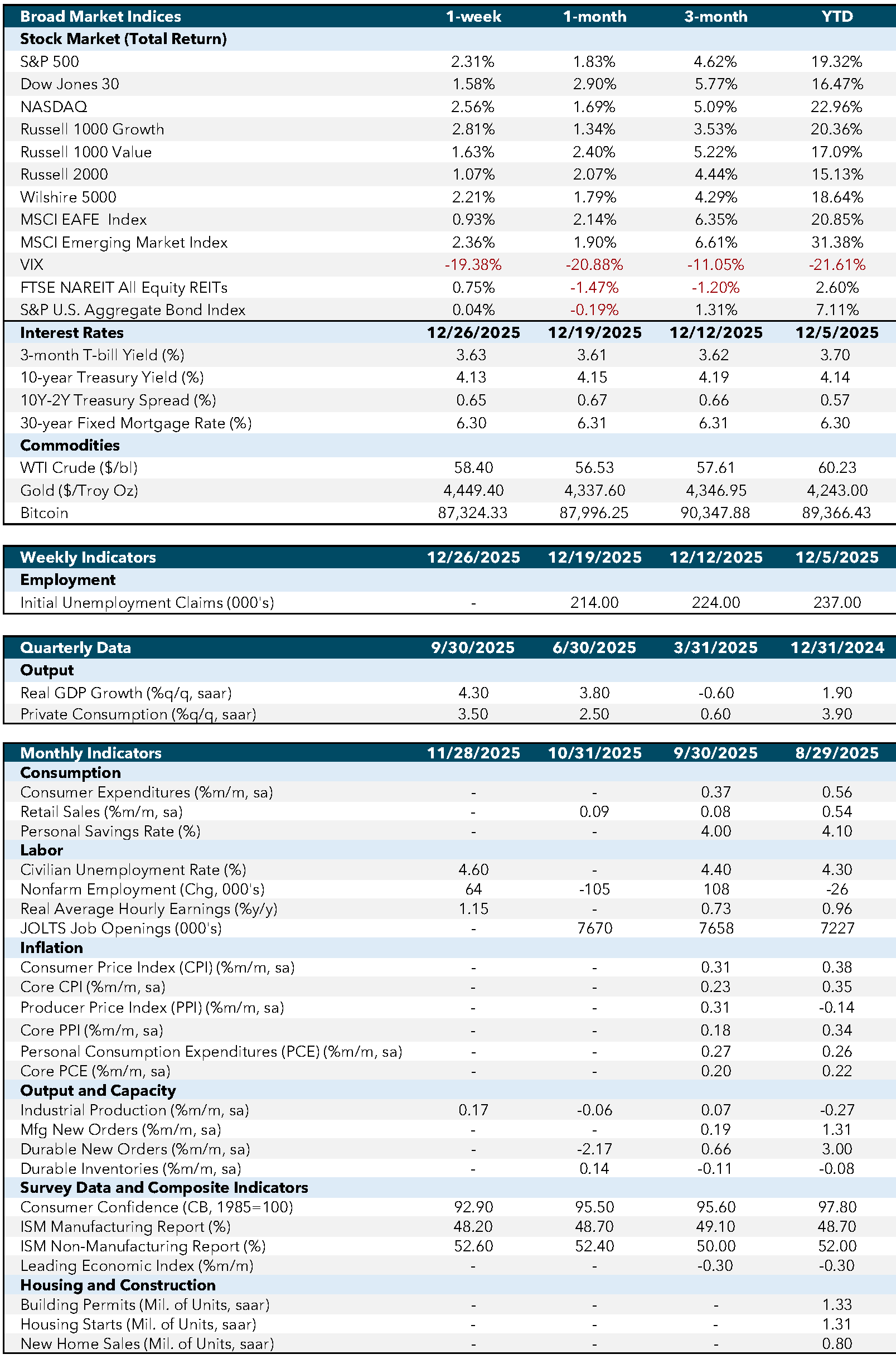
On Tuesday, Durable Goods Orders for November fell 2.2% month-over-month, a sharper decline than expected and a reversal from October’s gain. The weakness was driven by a steep drop in transportation equipment, particularly civilian aircraft orders. Excluding transportation, core orders rose a modest 0.2%, suggesting underlying manufacturing demand remains steady despite sector volatility.
Also Tuesday, the final estimate of third-quarter gross domestic product (GDP) confirmed strong growth at an annualized 4.3%. Consumer spending and government outlays were key contributors, while inflation measures such as the Personal Consumption Expenditures (PCE) Price Index held at 2.8%, indicating price pressures remain elevated but manageable. In contrast, the Conference Board’s Consumer Confidence Index fell to 89.1 in December from 92.9 in November. The Present Situation Index dropped sharply, reflecting concerns about labor conditions and inflation, while expectations stayed subdued — signaling persistent caution among households heading into 2026.
On Wednesday, weekly jobless claims offered a more positive signal. Initial claims declined by 10,000 to 214,000, beating expectations and showing layoffs remain historically low. However, continuing claims edged up to 1.92 million, suggesting hiring may be slowing and more individuals are staying on unemployment rolls longer. This points to a labor market that is steady but cautious as employers maintain staffing levels without aggressively expanding.
In summary, last week’s data paints a mixed picture: economic growth remains strong, but consumer sentiment is weakening, and manufacturing faces headwinds from transportation volatility. The labor market continues to show resilience, though signs of cooling persist. As we move into the new year, markets and policymakers will watch closely to see whether consumer caution and slower hiring begin to weigh on broader momentum.
Economic and Capital Markets Dashboard
Week Ahead…

It will be another shortened week, but several important releases could shape market sentiment as we close out the year.
On Tuesday, the Federal Reserve will publish the minutes from its most recent Federal Open Market Committee (FOMC) meeting. These minutes will provide deeper insight into policymakers’ discussions around inflation, growth, and the timing of future rate adjustments. Markets will be looking for any signals on how firmly the Fed intends to maintain its current stance or whether conditions could prompt a shift in 2026.
Wednesday brings the latest weekly jobless claims, a key gauge of labor market stability. While claims have remained historically low, any change in trend could influence expectations for consumer spending and overall economic resilience. Also on Wednesday, the Chicago Purchasing Managers’ Index (PMI) will offer a regional snapshot of manufacturing activity. This measure often serves as an early indicator of broader industrial trends and supply chain dynamics.
Finally, on Friday, the Manufacturing PMI will provide a national view of factory conditions. This report is closely watched for signs of expansion or contraction in the sector, which plays a critical role in economic momentum.
Together, these releases will help clarify whether growth and labor strength can persist amid cautious consumer sentiment and ongoing inflation concerns.
Economic Indicators:
- CPI: Consumer Price Index measures the average change in prices paid by consumers for goods and services over time. Source: Bureau of Labor Statistics.
- Core CPI: Core Consumer Price Index excludes food and energy prices to provide a clearer picture of long-term inflation trends. Source: Bureau of Labor Statistics.
- PPI: Producer Price Index measures the average change in selling prices received by domestic producers for their output. Source: Bureau of Labor Statistics.
- Core PPI: Core Producer Price Index excludes food and energy prices to provide a clearer picture of long-term inflation trends. Source: Bureau of Labor Statistics.
- PCE: Personal Consumption Expenditures measure the average change in prices paid by consumers for goods and services. Source: Bureau of Economic Analysis.
- Core PCE: Core Personal Consumption Expenditures exclude food and energy prices to provide a clearer picture of long-term inflation trends. Source: Bureau of Economic Analysis.
- Industrial Production: Measures the output of the industrial sector, including manufacturing, mining, and utilities. Source: Federal Reserve.
- Mfg New Orders: Measures the value of new orders placed with manufacturers for durable and non-durable goods. Source: Census Bureau.
- Durable New Orders: Measures the value of new orders placed with manufacturers of durable goods. Source: Census Bureau.
- Durable Inventories: Measures the value of inventories held by manufacturers for durable goods. Source: Census Bureau.
- Consumer Confidence (CB, 1985=100): Measures the degree of optimism that consumers feel about the overall state of the economy and their personal financial situation. Source: Conference Board.
- ISM Manufacturing Report: Measures the economic health of the manufacturing sector based on surveys of purchasing managers. Source: Institute for Supply Management.
- ISM Non-Manufacturing Report: Measures the economic health of the non-manufacturing sector based on surveys of purchasing managers. Source: Institute for Supply Management.
- Leading Economic Index: Measures overall economic activity and predicts future economic trends. Source: Conference Board.
- Building Permits (Mil. of Units, saar): Measures the number of new residential building permits issued. Source: Census Bureau.
- Housing Starts (Mil. of Units, saar): Measures the number of new residential construction projects that have begun. Source: Census Bureau.
- New Home Sales (Mil. of Units, saar): Measures the number of newly constructed homes sold. Source: Census Bureau.
- SA: Seasonally adjusted.
- SAAR: Seasonally adjusted annual rate.
Market Indices & Indicators:
- S&P 500: A market-capitalization-weighted index of 500 leading publicly traded companies in the U.S., widely regarded as one of the best gauges of large U.S. stocks and the stock market overall.
- Dow Jones 30: Also known as the Dow Jones Industrial Average, it tracks the share price performance of 30 large, publicly traded U.S. companies, serving as a barometer of the stock market and economy.
- NASDAQ: The world’s first electronic stock exchange, primarily listing technology giants and operating 29 markets globally.
- Russell 1000 Growth: Measures the performance of large-cap growth segment of the U.S. equity universe, including companies with higher price-to-book ratios and growth metrics.
- Russell 1000 Value: Measures the performance of large-cap value segment of the U.S. equity universe, including companies with lower price-to-book ratios and growth metrics.
- Russell 2000: A market index composed of 2,000 small-cap companies, widely used as a benchmark for small-cap mutual funds.
- Wilshire 5000: A market-capitalization-weighted index capturing the performance of all American stocks actively traded in the U.S., representing the broadest measure of the U.S. stock market.
- MSCI EAFE Index: An equity index capturing large and mid-cap representation across developed markets countries around the world, excluding the U.S. and Canada.
- MSCI Emerging Market Index: Captures large and mid-cap representation across emerging markets countries, covering approximately 85% of the free float-adjusted market capitalization in each country.
- VIX: The CBOE Volatility Index measures the market’s expectations for volatility over the coming 30 days, often referred to as the “fear gauge.”
- FTSE NAREIT All Equity REITs: Measures the performance of all publicly traded equity real estate investment trusts (REITs) listed in the U.S., excluding mortgage REITs.
- S&P U.S. Aggregate Bond Index: Represents the performance of the U.S. investment-grade bond market, including government, corporate, mortgage-backed, and asset-backed securities.
- 3-Month T-bill Yield (%): The yield on U.S. Treasury bills with a maturity of three months, reflecting short-term interest rates.
- 10-Year Treasury Yield (%): The yield on U.S. Treasury bonds with a maturity of ten years, reflecting long-term interest rates.
- 10Y-2Y Treasury Spread (%): The difference between the yields on 10-year and 2-year U.S. Treasury bonds, often used as an indicator of economic expectations.
- WTI Crude ($/bl): The price per barrel of West Texas Intermediate crude oil, a benchmark for U.S. oil prices.
- Gold ($/Troy Oz): The price per troy ounce of gold, a standard measure for gold prices.
- Bitcoin: A decentralized digital currency without a central bank or single administrator, which can be sent from user to user on the peer-to-peer bitcoin network.
This content was developed by Cambridge from sources believed to be reliable. This content is provided for informational purposes only and should not be construed or acted upon as individualized investment advice. It should not be considered a recommendation or solicitation. Information is subject to change. Any forward-looking statements are based on assumptions, may not materialize, and are subject to revision without notice. The information in this material is not intended as tax or legal advice.
Investing involves risk. Depending on the different types of investments there may be varying degrees of risk. Socially responsible investing does not guarantee any amount of success. Clients and prospective clients should be prepared to bear investment loss including loss of original principal. Indices mentioned are unmanaged and cannot be invested into directly. Past performance is not a guarantee of future results.
The Dow Jones Industrial Average (DJIA) is a price-weighted index composed of 30 widely traded blue-chip U.S. common stocks. The S&P 500 is a market-cap weighted index composed of the common stocks of 500 leading companies in leading industries of the U.S. economy. The NASDAQ Composite Index is a market-value weighted index of all common stocks listed on the NASDAQ stock exchange.
Securities offered through Cambridge Investment Research, Inc., a broker-dealer, member FINRA/SIPC, and investment advisory services offered through Cambridge Investment Research Advisors, Inc., a Registered Investment Adviser. Both are wholly-owned subsidiaries of Cambridge Investment Group, Inc. V.CIR.1229-4676